The Flags of Ireland: A Visitor's Guide to the Tricolour and Everything Around It
Ireland is a small island with a lot of flags: the tricolour, the harp banner, four provinces, county colours, and the flags of Northern Ireland. What each one is, where it came from, and what it means, so you can read the landscape as you travel.
Last checked October 2026
If you read nothing else
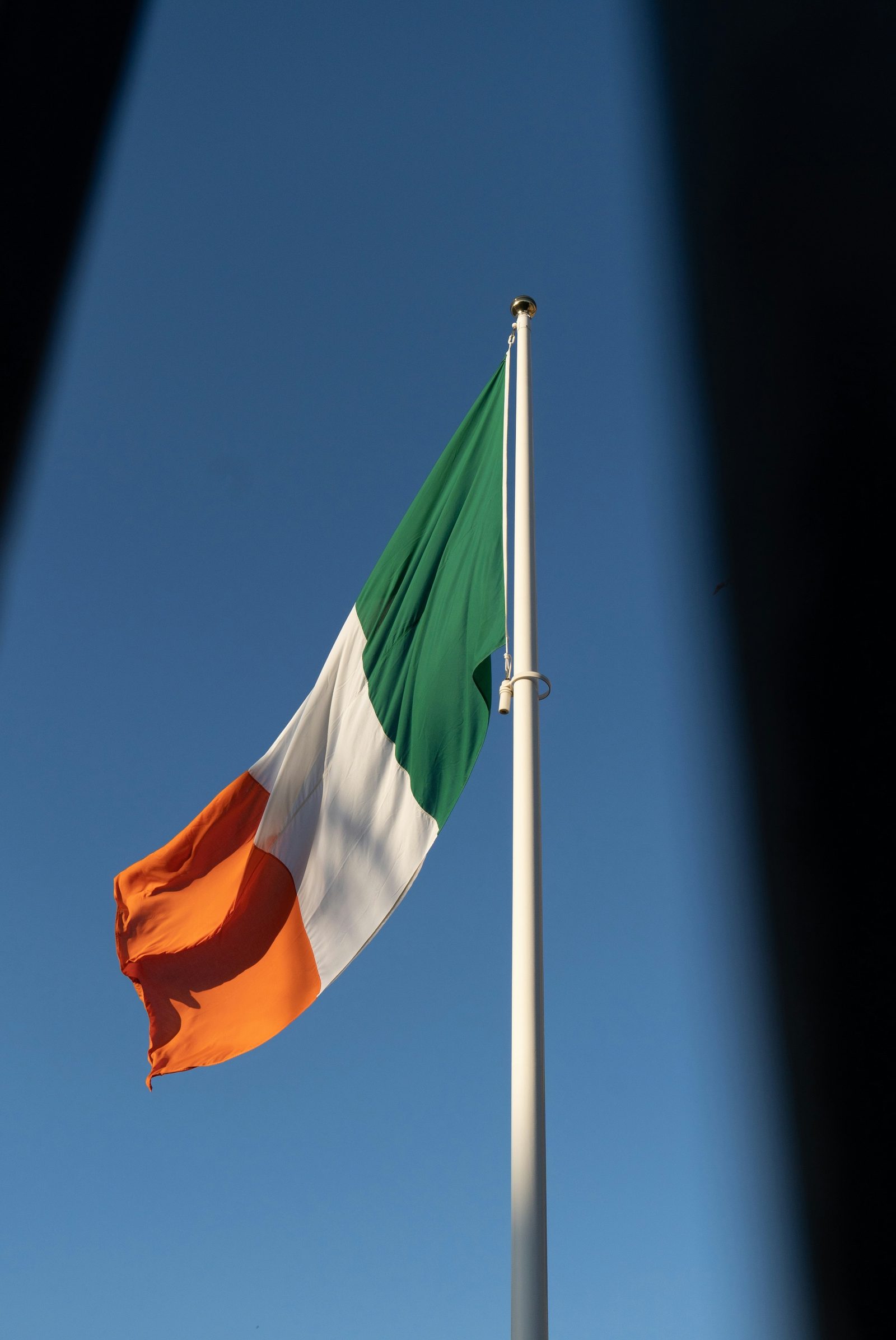
- The national flag of Ireland is the tricolour: vertical bands of green, white and orange, green next to the pole. It was designed in 1848 as a symbol of peace between Ireland's two traditions: green for the Gaelic and Catholic tradition, orange for the Protestant tradition associated with William of Orange, and white between them for a lasting truce.
- The flag rules are guidelines, not law. The Department of the Taoiseach publishes protocol guidance and states plainly that there are no statutory requirements. But the flag is treated with real respect: it should never touch the ground, never be flown torn or faded, and never have words or logos printed on it.
- The third colour is orange, not gold. Calling it "green, white and gold" is the most common visitor mistake. Official guidance says the substitution destroys the flag's symbolism.
- The harp came first. A gold harp on a green field was Ireland's best-known banner for centuries before 1848, and it survives today as the flag of Leinster and the Irish naval jack. A gold harp on blue is the Presidential Standard.
- Northern Ireland has no official flag of its own. The Union Flag is the official flag there; the tricolour, the old Ulster Banner and community flags are all flown by different communities, and flags there can carry strong local meaning. Look, learn, and be respectful. Don't touch or move anyone's flag.
This guide is general information, checked against the sources listed at the foot of the page. Where historians disagree about a flag's origin, we say so.
1. The tricolour: a flag designed as a peace offer
Waterford, 1848
The tricolour was first flown publicly on 7 March 1848, from the Wolfe Tone Confederate Club at 33 The Mall, Waterford, by Thomas Francis Meagher, a young Waterford-born leader of the Young Ireland movement. Tricolours had been mentioned in Ireland as early as 1830 and 1844, and that spring they were appearing at meetings all over the country alongside French flags, in celebration of the revolution in France. But 1848 is when the design took hold.
A month later, on 15 April 1848, Meagher presented a finer version, a silk tricolour brought from Paris, to a meeting in Dublin, and explained what it meant. His words are the key to the whole flag, and they are worth quoting exactly:
"The white in the centre signifies a lasting truce between the 'Orange' and the 'Green', and I trust that beneath its folds the hands of the Irish Protestant and the Irish Catholic may be clasped in generous and heroic brotherhood."
The Department of the Taoiseach's official booklet puts the same idea in modern language: the tricolour "is intended to symbolise the inclusion and hoped-for union of the people of different traditions on this island."
- Green stands for the older Gaelic tradition of Ireland (and, in the politics of 1848, for Catholic Ireland). A green flag had been the nationalist banner for two centuries (see the harp flag, below).
- Orange stands for the Protestant tradition: the supporters of William of Orange, the Protestant king whose victory at the Battle of the Boyne in 1690 was (and is) commemorated by the Orange Order, founded in 1795.
- White is not a third group. It is the point of the flag: a lasting truce between the other two.
One honest detail from the official history: the 1848 flags were not standardised. All showed green, white and orange, but some put orange next to the staff, and at least one reversed the order entirely. The fixed pattern, green at the hoist, came later.
From rebel banner to national flag
- 1848: First flown in Waterford (7 March); silk flag presented in Dublin (15 April).
- 1848–1916: Little used. The green harp flag remained the popular national banner right up to the eve of the Easter Rising.
- 1916: Flown over the GPO in Dublin during the Easter Rising; it captured the national imagination as the banner of the new Ireland.
- 1922: Used officially by the Irish Free State (1922–1937).
- 1937: Given constitutional status. Article 7 of the Constitution of Ireland states: "The national flag is the tricolour of green, white and orange."
The design, precisely
From the Department of the Taoiseach's published guidance:
- Rectangular, twice as wide as it is deep (ratio 1:2).
- Three vertical bands of equal size: green (next to the staff), white, orange.
- Official Pantone colours: green 347, orange 151.
- It should normally be displayed on a staff. Displayed flat against a wall horizontally, the green goes on the observer's left; hung vertically, green uppermost.
2. Flag protocol: the official guidance, in plain English
Ireland's flag protocol is unusual in one respect visitors often miss: it is guidance, not law. The Department of the Taoiseach has general responsibility for the national flag, its role is advisory, and, in the words of its own booklet, "there are no statutory requirements… It is expected, however, that the National Flag will be treated at all times with appropriate respect." A Taoiseach's answer in the Dáil on 1 October 2025 confirmed the same position: guidelines are published on gov.ie, and observance is a matter for each individual.
The main points of the guidance:
Precedence and placing
- No flag or pennant should be flown above the national flag.
- Carried with other flags, the national flag takes the place of honour: the marching right, which is the left of an observer watching the flags approach.
- In a line of flags on equal staffs, the national flag is first on the right of the line (the observer's left). Only one national flag should appear in each group.
Hoisting, lowering and daily display
- The flag should be displayed in the open only between sunrise and sunset, except during public meetings, processions or funerals, when it may fly for the duration of the event.
- In raising or lowering, it must not be allowed to touch the ground.
- It is normal practice to fly the national flag daily at all military posts and from a limited number of important State buildings, including Áras an Uachtaráin (the President's residence), Leinster House (the seat of the Oireachtas) when in session, Irish courts, embassies and consulates, and Garda stations.
- It is flown from State buildings with flagpoles on St Patrick's Day, Easter Sunday and Easter Monday (in commemoration of the 1916 Rising), and the National Day of Commemoration (the Sunday closest to 11 July).
Half-mast
- The flag is frequently flown at half-mast on the death of a national or international figure, on prominent government buildings; a prominent local death may be marked locally.
- When hoisting to half-mast, raise it first to the peak, then lower it to the half-mast position, and raise it to the peak again before finally lowering it.
- Where the national flag is at half-mast, no other flag should be half-masted.
Things the guidance says not to do
- Never deface the flag by placing slogans, logos, lettering or pictures on it. The booklet gives sporting events as the example.
- Do not drape it on cars, trains, boats or other transport, and do not use it to cover a speaker's desk or drape a platform. (On a platform it belongs above and behind the speaker's desk.)
- It should always be carried aloft and free, never carried flat. The one exception is draping a coffin, when the green goes at the head of the coffin.
- Take care that it does not touch the ground, trail in water, or become entangled in trees or other obstacles.
Worn-out flags
- When the flag "has become worn or frayed it is no longer fit for display, and should not be used in any manner implying disrespect."
- Note what the official booklet does not do: it prescribes no single disposal method. Private, dignified destruction is the widely followed practice, but it is custom, not a rule laid down by the Department. We flag this because many websites state a specific method as if it were official. It isn't in the published guidance.
3. Mistakes visitors make (all easily avoided)
- "Green, white and gold." The third band is orange, and the distinction is the whole meaning of the flag. The official booklet is blunt: yellow or gold is sometimes substituted, and "by this substitution the fundamental symbolism is destroyed." People do say "gold" affectionately in song and speech, but on the flag itself, it's orange.
- Flying it backwards. Green goes next to the pole. A tricolour flown orange-at-the-hoist is, stripe for stripe, the flag of Côte d'Ivoire (which also uses different proportions: a handy way to tell them apart).
- Printing on it. Flags sold with text, crests, or "Ireland" lettered across them are souvenirs, not the national flag; official guidance treats lettering and logos as defacement.
- Flying a tattered flag. A faded, frayed tricolour over a pub or house isn't seen as patriotic. The guidance says a worn flag is no longer fit for display.
- Assuming one flag covers the whole island. The tricolour is the national flag of Ireland (the state). Northern Ireland is part of the United Kingdom, has no official flag of its own, and the Union Flag is its official flag. In practice you'll see different flags flown by different communities there. See sections 6 and 8 below.
4. The harp flag: the banner that came before
Long before the tricolour, Ireland's emblem was the harp. The Department of the Taoiseach's history notes that "a green flag with harp was an older symbol of the nation, going back at least to Confederate Ireland and Owen Roe O'Neill in the 1640s," and was widely adopted by the Volunteers and the United Irishmen.
The most celebrated early sighting is specific: the ship St Francis, lying at anchor at Dunkirk with Owen Roe O'Neill aboard, is recorded as flying "the Irish harp in a green field" from her masthead. Through the 18th and 19th centuries the green harp flag was the nationalist banner. The tricolour was the newcomer, and even in 1916 the green flag was raised alongside it.
The harp itself is Ireland's state emblem to this day (you'll see it on euro coins, passports and official seals), and the green harp flag never went away. It survives, formally, in two places in this guide: as the flag of Leinster, and as the naval jack.
5. The four provincial flags
Ireland's four provinces (Leinster, Munster, Connacht and Ulster) each have a traditional flag. A necessary honesty note first: these are traditional, attributed arms, not officially adopted flags. They are banners of arms: flags made from coats of arms whose origins are medieval, debated, and in places frankly uncertain. They fly everywhere anyway: at GAA grounds, at provincial rugby matches, and quartered together in the Four Provinces flag, used by all-Ireland sports teams and cultural organisations precisely because it represents the whole island without choosing a state flag.
Leinster: the harp
A gold harp with silver strings on a green field: the harp flag of section 4, adopted as the province's arms. The arms are believed to have evolved from the arms of Ireland itself, with the field changed to green.
Munster: the three crowns
Three gold antique crowns on a blue (azure) field. The crowns are drawn in an old style: a gold rim with pointed triangular rays. Where they come from is not certain: they are thought to derive from the arms of the former Lordship of Ireland, or from the short-lived Dukedom of Ireland created for Robert de Vere in 1386. An antique crown of this type also appears on a 13th-century crozier head found near Cormac's Chapel on the Rock of Cashel, where the king-bishops of Cashel used it as an assertion of sovereignty over Munster.
Connacht: the eagle and the sword arm
The strangest of the four, split vertically: on one side a black eagle, halved (heraldically "dimidiated"); on the other, an armoured arm rising from the dividing line, holding a sword upright. The design is believed to come from the arms of the Schottenkloster, the Irish ("Scoti") monastery in Regensburg, Germany, whose arms combined the Imperial eagle with an armed arm. It is surmised that the arms were granted to Ruaidhrí O'Conchobhair (Rory O'Connor), King of Connacht and the last High King of Ireland before the Norman invasion, in return for his patronage of the abbey.
Ulster: the Red Hand and the de Burgh cross
A red cross on a gold field (the arms of the de Burgh family, Earls of Ulster), with a small white shield at the centre bearing a red right hand, palm forward, cut off at the wrist: the emblem of the O'Neills, kings of Aileach and Tír Eoghain (Tyrone).
The Red Hand's origin is genuinely uncertain, and the famous story is a legend. The tale usually told, that in an ancient boat race for the kingship of Ulster, the first man to touch the shore would win, so one competitor cut off his own hand and threw it ashore ahead of him, is a great story, and it is told everywhere. But it is folklore, not recorded history, and heraldic sources treat the hand's true origin as unknown. The Red Hand is also a shared symbol: it appears in both nationalist and unionist contexts in Ulster (including in the Ulster Banner, below), and on the crests of clubs and counties across the province.
A fifth province? Older heraldry also gives arms to Meath (Mide), the long-absorbed fifth province: a king enthroned on a blue field. You'll occasionally see it in five-province displays, but the four-province quartering is the standard form.
6. County colours: the flags of the GAA
Ireland has no official county flags. What flies over county grounds, fills Croke Park on final days, and hangs from windows every summer are the county colours of the GAA, the Gaelic Athletic Association, which serve as de facto county flags.
- Counties were formally asked to register their colours with the GAA's Central Council in 1913; by then many were already settled.
- In the GAA's early years, a county was represented by its champion club, so in many counties the colours are simply a successful club's colours, worn into permanence. The GAA's own history gives Tipperary's blue and gold a debt to the Tubberadora club, and Kerry's green and gold to the Tralee Mitchels.
- Some colours stuck because a team won in them. The GAA records that Cork's red and white date from 1919, when British troops raided the county board's rooms and seized Cork's blue jerseys; Cork borrowed a red set from a local temperance hall team, won, and never went back.
- Mayo's green and red can be traced to 1887.
- Green (alone, with white, or with gold/orange) dominates, reflecting the GAA's nationalist roots; blue is the other common thread.
For a visitor, the practical point is simple: on match days, the colours are the county. A sea of green and red is Mayo; blue and gold is Tipperary; maroon and white is Galway. County councils have since designed coats of arms (often borrowing the GAA colours), and you'll see those arms on the county flags flown at Dublin Castle. But the jersey colours came first, and they are the ones people feel in their chest.
7. The Presidential Standard
The personal flag of the President of Ireland is a banner of the state arms: a gold harp on a deep blue field ("St Patrick's blue"). Points of protocol worth knowing:
- It was approved by the Government on 13 February 1945 and first raised at Áras an Uachtaráin on 24 May 1945, in the presence of President Douglas Hyde, shortly before his successor's inauguration.
- It flies over Áras an Uachtaráin and Dublin Castle when the President is in residence, and on vehicles used by the President.
- It is never flown at half-mast.
- Unusually for a head of state's standard, it never takes precedence over the national flag.
The blue field is deliberate history: a gold harp on blue was the older form of Ireland's arms (it is the version that appears in the Royal Standard of the United Kingdom), while the green field became the nationalist variant. The President's standard keeps the blue.
8. Flags at sea: ensign, jack and colour
- Naval ensign: The Irish Naval Service flies the national tricolour as its ensign. Ireland has no separate naval ensign.
- Naval jack: Adopted in 1947, the jack is the historic green flag returned to service: a gold harp on a green field. It is flown at the jack staff (at the bow) when a ship is at anchor, moored or alongside, or when under way and dressed with masthead ensigns, and it is hoisted and half-masted in step with the ensign.
- Naval Service Colour: A ceremonial colour introduced in 1996, a square, double-sided, navy-blue banner with a gold fringe; the obverse carries the Defence Forces badge over crossed silver foul anchors, the reverse the state harp within a naval rope border.
9. Defence Forces colours, briefly
Beyond the naval colour, Ireland's brigades, corps and units carry their own flags and ceremonial colours bearing their badges and names (in Irish and English): for example the brigade flags of 1 Brigade and 2 Brigade, and the Air Corps flag, which sets the corps emblem on a blue field crossed by red and yellow diagonals. Colours are paraded on state ceremonial occasions (guards of honour, national commemorations and veterans' days) and are treated as the physical embodiment of a unit's honour and history.
10. Historical flags you'll meet in museums and murals
St Patrick's Saltire
A red diagonal cross (saltire) on a white field. Its association with St Patrick dates from the 1780s, when the Order of St Patrick, a chivalric order founded by George III in 1783, adopted it as its emblem. Where the design came from before that is genuinely disputed: the most common theory derives it from the arms of the FitzGerald (Geraldine) dynasty, Earls of Kildare and later Dukes of Leinster, whose arms were a red saltire on white; some nationalists have long objected to it as a British invention, and the honest position is that its earlier history is not settled.
What is certain is its most famous use: when the Acts of Union joined Ireland with Great Britain, the saltire was added to the Union Flag in 1801 to represent Ireland, layered with the crosses of St George (England) and St Andrew (Scotland). It remains Ireland's component of the Union Flag today, and the saltire itself still appears across Irish institutional life: in university and municipal arms, regimental colours, and the badge of the Police Service of Northern Ireland.
The Starry Plough
The flag of the Irish Citizen Army, the workers' militia formed during the 1913 Dublin Lockout. Unveiled on 5 April 1914, it shows a stylised gold plough beneath the seven silver stars of the Plough (Ursa Major) on a green field: the plough for the working people who made up the Citizen Army, the stars for the constellation that shares its name. During the 1916 Easter Rising it was flown over the Imperial Hotel on O'Connell Street (the building now occupied by Clery's), opposite the GPO. The original 1914 flag was captured during the Rising and spent decades in Britain; it later returned to Ireland and is now preserved in the National Museum of Ireland at Collins Barracks, Dublin. It is one of the few flags in this guide you can stand in front of. A simplified version, seven white stars on a sky-blue field, introduced in the 1930s, became the emblem of the wider Irish labour movement.
The Sunburst (An Gal Gréine)
A golden sun rising, most often shown as a half-sun with rays at the lower edge or corner of the flag, in its best-known later form, on a blue field. The design reaches back to the literature of the Fianna, the mythical warrior band, who were said to call their banner Gal Gréine, "sunburst." The Fenian movement adopted it in the 19th century: the Irish Republican Brotherhood took up the sunburst from 1858, Irish regiments carried it during the American Civil War, and Conradh na Gaeilge (the Gaelic League, founded 1893) used the sunburst flag for its literary associations. It is still used by Irish-language and cultural organisations today.
The Orange Standard
The flag of the Orange Order, the Protestant fraternal organisation founded in 1795 to commemorate William of Orange. In its common form it is an orange field with a purple star, the star being a Williamite symbol, and a widely used variant adds the red cross of St George in the canton (the upper corner at the hoist). It is carried on Orange parades, above all on the Twelfth of July, the Order's principal commemoration of William's victory at the Boyne. We describe it as we describe every flag in this guide: it is part of the island's flag landscape, and visitors in Northern Ireland in the summer will see it.
11. Flags you'll actually see on your trip
- Over public buildings: In the Republic, the tricolour, often with the EU flag alongside. In Northern Ireland, the Union Flag flies over government buildings on designated days under UK practice.
- Outside pubs and hotels: Tricolours, harp flags, provincial and county flags, and, in tourist areas, a friendly clutter of visitors' flags. Quality varies; the protocol in section 2 is what officialdom does, not what every pub does.
- At GAA grounds: County colours everywhere: flags, bunting, headbands, painted kerbs in strong counties in championship season (high summer). This is the most joyful flag culture on the island and the easiest to join: pick the county you're standing in.
- At rugby and other all-Ireland sports: The Four Provinces flag, or team-specific flags based on it, flown precisely so that supporters from both jurisdictions stand under one banner.
- On 17 March: Tricolours and St Patrick's Saltire both appear around St Patrick's Day. The saltire is flown by some local authorities and churches for the day itself.
- In Northern Ireland in marching season: Parades run through the summer, with the Twelfth of July the largest Orange occasion. You will see the Orange Standard, Union Flags, the Ulster Banner (the former Northern Ireland government flag of 1953–1972: a red cross with the Red Hand, a six-pointed star and a crown; it has had no official status since 1972 but is still widely flown and used by some Northern Ireland sports teams), and in nationalist areas the tricolour and provincial flags. Some displays mark community territory. The visitor's rules are simple: don't touch, move or photograph people without asking, and if a parade is passing, watch from the pavement and let it pass. It is the same courtesy you'd extend any procession.
- On cars: Officially, the flag should never be draped on a vehicle. In practice, small flags appear on cars during championships and St Patrick's week. You'll know the difference between the souvenir and the real thing by now.
12. Seeing the 1848 story: Waterford
Waterford is where the tricolour begins, and it is an easy, rewarding stop:
- 33 The Mall: the Wolfe Tone Confederate Club building from whose window the flag was first flown on 7 March 1848. It is a private building today: you see it from the street, and Waterford walking tours of the Viking Triangle pause outside it. Don't expect a museum inside. There isn't one, whatever older articles imply.
- Waterford Treasures, the Bishop's Palace: the city's museum quarter on The Mall, a short walk from No. 33, telling Waterford's Georgian and Victorian story; Meagher was a son of this city (his father was its mayor), and the museums and the city's walking tours carry his story.
- The 1848 Tricolour Celebration: Waterford marks the anniversary each March with a flag-raising ceremony in the city. If your trip falls in early March, it is the single best flag event in Ireland to plan around.
- In Dublin: the National Museum at Collins Barracks holds the original 1914 Starry Plough, and the GPO on O'Connell Street, where the tricolour flew in 1916 and where a tricolour still flies today, is the other essential flag pilgrimage. Look up: the statue on the GPO roof is Hibernia, Ireland personified, with her harp and spear (our second photo on this page).
Sources
- Department of the Taoiseach: The National Flag booklet (history; design and Pantone colours; precedence, hoisting, occasions, practices to avoid; "no statutory requirements"; worn-flag rule): gov.ie, Department of the Taoiseach, Protocol Section.
- Dáil Éireann debate, 1 October 2025: Taoiseach's answer confirming the guidelines are published on gov.ie and are not statutory: debatesarchive.oireachtas.ie.
- Constitution of Ireland, Article 7: "The national flag is the tricolour of green, white and orange."
- Thomas F. Meagher Foundation / 1848 Tricolour Celebration, Waterford: first flying at 33 The Mall, 7 March 1848, and Meagher's 15 April 1848 words: meagherstricolour.com; waterfordvisitorcentre.com.
- Genealogical Office / Chief Herald material on the arms of the four provinces (Leinster, Munster, Connacht, Ulster blazons and origins), via Coat of arms of Ireland and Armorial of Ireland reference summaries.
- Presidential Standard: Government approval 13 February 1945; first raised at Áras an Uachtaráin 24 May 1945; never half-mast; never takes precedence over the national flag: List of flags of Ireland (citing the Chief Herald's office records).
- Naval Service flags: jack adopted 1947, flown at the jack staff when at anchor/moored/alongside or dressed; Naval Service Colour 1996: Defence Forces / military.ie flag descriptions via Flags of the World (FOTW).
- GAA: "History woven into the colours sported in battle" (1913 registration of county colours; champion-club origins; Cork 1919; Mayo 1887): gaa.ie. See also FIAV ICV27 paper on county flags (no official county flags; GAA colours as de facto county flags).
- Starry Plough: unveiled 5 April 1914; Imperial Hotel, 1916; original in the National Museum of Ireland, Collins Barracks; 1930s blue labour version: History Ireland, "A brief history"; SIPTU, "Unfurling the Starry Plough."
- St Patrick's Saltire: Order of St Patrick 1783; FitzGerald origin theory presented as disputed; added to the Union Flag 1801: Encyclopaedia/reference summaries of the saltire's history.
- Sunburst (Gal Gréine): Fianna literary origin; IRB adoption 1858; Conradh na Gaeilge 1893: FOTW, "Ireland: Sunburst" (Vincent Morley).
- Orange Order flag: orange field, purple (Williamite) star; variant with St George's Cross in the canton: CAIN (Conflict Archive on the Internet), Ulster University: Symbols: Flags Used in Northern Ireland.
- Waterford visits: Waterford Treasures / Bishop's Palace and Viking Triangle walking tours passing 33 The Mall: Visit Waterford tour listings.
Written by the Irish Escapes team. Flag protocol guidance changes rarely, but we re-check this page against the Department of the Taoiseach's published guidance; the "Last checked" date at the top is the date of the most recent full check.
Questions, answered
Is it "green, white and gold" or "green, white and orange"?
Orange. Gold is a common affectionate substitution in speech and song, but the Constitution says orange, and the Department of the Taoiseach's guidance says substituting yellow or gold destroys the symbolism, because orange stands for a specific tradition the flag was designed to include.
Is it illegal to fly the Irish flag the wrong way, or at night?
No. Ireland has no statutory flag code. The Department of the Taoiseach publishes guidelines (green at the hoist, flown between sunrise and sunset except for events, never touching the ground), and observance is a matter of respect, not law.
What is the difference between the Irish flag and the Ivory Coast flag?
Order and proportions. Ireland: green–white–orange, twice as wide as deep (1:2). Côte d'Ivoire: orange–white–green, in 2:3 proportions. If green is at the pole, it's Ireland.
Why is there a harp on everything: coins, passports, the President's flag?
The harp is Ireland's state emblem and has been associated with Ireland since the medieval period. On a green field it forms the old national banner and Leinster's flag; on blue it forms the arms of Ireland and the Presidential Standard. (Guinness's famous harp faces the other way: the brewery registered its trademark first, and the state's harp was adopted facing the opposite direction.)
Does Northern Ireland have its own flag?
No official one. The Ulster Banner was the flag of the Northern Ireland government from 1953 until that government was abolished in the early 1970s; it lost official status then but is still widely flown and used by some sports teams. The official flag of Northern Ireland, as part of the United Kingdom, is the Union Flag.
What should I do if I see a flag display I don't understand in Northern Ireland?
Nothing special. Look, and carry on. Flags there can mark community identity and territory as well as celebration. Don't move or touch flags, don't photograph people beside them without asking, and don't read a flag as a warning sign aimed at you: visitors pass through flag-lined streets every day of the summer without incident.